

 +49 800 770 90 90
  Contact



Valves
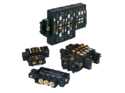
Valves are components which are used to regulate and to shut off diverse media such as gases and various liquids. Inside the valves, a closure component such as a ball or a cone is moved almost parallel to the respective flow direction of the medium. The flow of the media is interrupted or reduced when the entire circumference of the closure component is pressed onto a suitably shaped opening.
In comparison with other components such as butterfly valves, ball valves and gate valves that are used to shut-off flowing media, valves can be designed so that they have a uniform flow pattern within the flow cross-section over the entire adjustment range. This makes valves particularly suitable for performing regulation tasks in addition to shut-off tasks.
Valves can also be subdivided according to the different types of actuation. Manually operated valves: They are usually moved with a handwheel. They are further distinguished into models with a rising stem and those with a non-rising stem. For larger nominal diameters, a gear should be connected in between. A manual control can also be mounted as an emergency override if an emergency occurs during normal motor operation.
Medium actuated valves: They act, for example, as angle or globe valves or as check and pinch valves. In addition, a distinction is made between valves actuated by an external medium and valves actuated by their own medium. Electromotively (mechanically) actuated valves with valve gear that can be either pneumatic or electric. Electromagnetically actuated valves, which, in turn, are divided into several subtypes, for example: Direct-operated 2/2-way valves, also known as globe valves, and 3/2-way valves, which have two valve seats and three connections.
Servo-operated valves: If the respective diameter increases, the individual static compressive force also increases. In order to overcome this, an adapted higher magnetic force is required. Positively-operated valves: Here, the actual valve seats are sealed either by a diaphragm or a corresponding piston, which is bound to a magnetic core. Pilot-operated valves: These models are equipped with a 3/2-way pilot solenoid valve.
Externally controlled valves: In these models, an external medium is used for control as compared to the pilot-operated valves. Some models, however, have the option of operating the control system with the operating medium. These are usually diaphragm-controlled or piston-controlled valves. The valve seat is blocked during depressurisation.